Welcome!

Thanks for visiting Trapping Supplies Review. This is a place for trappers to share their insights on all things related to trapping. If you would like to contribute a trapping article, equipment review or stories and pictures from your trapline, please click "contact me" in the sidebar and I'll be happy to include your post. Meantime, please feel free to post comments on any topic if you have additional insights. Together we can make this website a valuable resource for trappers.

PETA Does Porn

The trappers I know are all about tradition, family and the love of the outdoors.  We don't have to resort to sleazy tactics or shameless marketing just to advance an agenda or get people to agree with us.  In contrast, I have begun to notice that our opponents are a particularly cheeky crowd.  They have resorted to sex to sell the animal rights agenda.

PETA's website promotes an animal rights video made by porn star Jenna Jameson.  The video intermixes scenes of a slaughterhouse with narration by the pouty porn star.  It's a weird combination.  The video is directed against McDonald's and is called McCruelty.  Get it?  McDonald's and McCruelty?  If that's not clever enough, they got as their spokesperson a true expert with impeccable credentials gained by having sex on camera.  Maybe she should run for the Senate.

PETA also has a naked Christian Serratos in an anti-fur advertisement that is captioned "I'd rather go naked than wear fur."  Of course the ad features a full view of the actress's behind.  I wonder if a partnership between PETA and Viagra is in the works?  

PETA's website headline is currently "2010's Sexiest Celebrity Vegetarians."  This kind of tabloid mentality says all you need to know about PETA and their agenda.  Use a pretty face instead of a good argument and you'll always get a few weak-minded followers (in a country that elects a community organizer as president). 

So, who is the sexiest celebrity vegetarian?  It's Olivia Wilde.  Yeah, she's pretty.  I've never seen a trapper that looked anywhere near as good.  OK, PETA, I guess you win.  The great debate over the relationship of people and animals in the world is over.  You have the sexiest celebrity on your side!

If only she was a trapper....
       
 Olivia Wilde 
(Image from Wikipedia)    

Predator Set with a Double Longspring Trap

Submitted by a friend in Oregon

I'm a longspring trap sort of guy. I'm not sure why. I collect them, tune them, rebuild them and modify them. I like the way they look hanging on my barn. It's something of an old-school mentality.


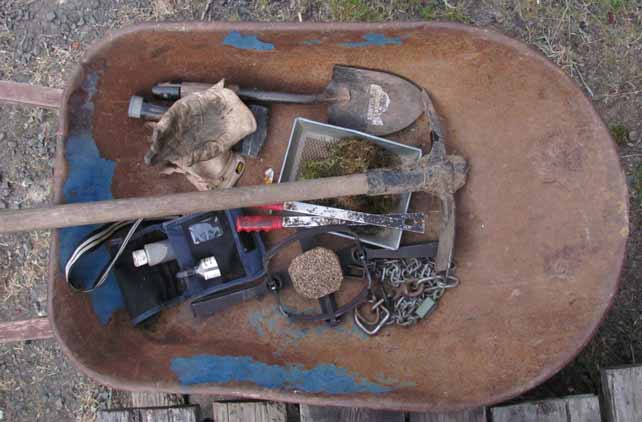
Here's how I make a set with a double longspring.  First I gather my tools and put them in my pack basket. LOL


I dig out a trap bed leaving some loosened soil in the bottom of the bed. Put the trap in with the dog towards the rock with the lure on it. Wiggle it back and forth while pushing it down until you get it solid in the bed. Push on the corners of the trap jaw to see if it tips. Place small stone under the loose jaw until the trap is solid in the bed.


We have some good moss here in Oregon that I dry out and lay around the pan in between the jaws.


A gob of gland lure goes on the rock with a light pile of fur needle duff, small bones, and a small chicken feather mixed in. A few inches to the left of that I put another type of gland lure on a rock and a little duff over it. Behind that I have taken a large rib bone and poked it in the dirt until just the top sticks out and saturated it with predator urine. I want the set to appear to a passing predator that several other predators have been scent marking there. The set is made off the main through trail a few feet and slightly built up on both sides with duff and such to create a slight walk through type path for the predator to follow while investigation the odors and the animal dropping placed in the trail just like a predator would.


There are small stones placed near the trap to guide the predators foot onto the trap. A couple of small branches lay behind the set to encourage the predator to work the set from the trap side. The trap is set on the north side of the scent being that the prevailing wind usually comes from the south east. Dirt and fur needle duff is sifted over the entire set to blend in and hide the trap.


Muskrat Colony Traps

by Garry McLaughlin
Newark, Ohio

(Note: Mr. McLaughlin's informative book on Muskrat trapping can be found at this link.)

     One of the best places to use colony traps is in narrows or pinch points.  Most people use them sucessfully in marshes but never dream of using them in streams. I use them often when I have a stream that has narrow places.  This stream is about 12 feet wide but it almost clogged with water weeds.


You will find that the muskrats will swim on the surface in these areas, so you must use diving sticks to force them to dive just before they get to your trap.  I place diving sticks about 4 or 5 inches from both ends of the trap right at the surface.


Another good place to use colony traps is at underwater holes that are out in a pond rather than next to the bank.  This photo shows a den entrance that is about 8 feet from shore due to the low water level in the pond.
 

 Hope this gives you younger fellows another way to catch a few rats ....... Garry

How Not To Release a Bobcat

I came across this on YouTube.  The video says it all.  Mess with the cat, you get the claws....

Dirt-Hole Pictorial

by Ricky Cox in Texas
Yoteman

I start by finding my location.  In this picture there's coyote tracks running down the left side of the dirt road beside the four wheeler.


Now I dig my bed in a bowl shape.


Then I drive my pogo stake right down in the center of my bed.


Now I dig my dirthole and bed my trap solid.


Now I sift the dirt over the trap and pour the chunks of dirt on both sides to form an upside down "V" shape back to the hole. I also make sure the area right above the trap pan is the lowest spot in my set.


Then I put a chunk of my favorite bait down the hole and cover it with a little clump of dead grass, or sheep's wool, etc... Then my lure goes on top of that in the hole and I might put just a little piece of backing at the back side of the hole. Here's the finished set:

Theft Resistant Anchor System

by Tracy Truman

If you've been trapping more than one season, you've no doubt had experience with losing a trap or two to a thief. I hate thieves. Really. I've often silently prayed that I might actually catch someone in the act of stealing my trap . . . but then I figured if the Lord determined their time here on earth was over, there were probably other, less messy ways to die.

Anyway, so like most of you, I've spent sleepless nights trying to come up with a totally foolproof, inexpensive, easy-to-use system to foil even the most clever thief. Uh, the only problem is I haven't found one yet. But I have found something that is pretty close. Its not for everyone, but it may be of some use to some of you.

At the outset, you have to have trees or rocks near your sets. OK, that was easy enough.

Here's the basic set up that I use for my cat traps.

First, I get a 7-10 foot 1/8" cable beaver drowner from the Snare Shop. You can make your own, of course, but invariably someone will want to know where I got mine, so now you know.

The beaver drowner has a loop at each end. Using J hooks, I attach one end to the trap chain swivel, and the other end I attach to a 1 1/2" flat washer, like so:


The beaver drowners come with a washer bent at a 90 degree angle, but in this application, it has no use, so just ignore it.

In this application, I'm anchoring to a rock ledge. So I get my handy-dandy cordless drill with a half inch masonry bit, and drill a hole about 3" deep in the rock.


Now I place the flat washer over the hole, and use a 2 1/2" inch long, 1/2" diameter concrete anchor bolt (about $1 at Home Depot or Lowes) through the washer.


Now smack the top of the bolt with your hammer a couple of times to drive it home.


Once the bolt is driven in, take your socket/ratchet and tighten the bolt. I then smack the bolt a few more times to "booger up" the threads so no would-be thief can simply loosen the bolt.

When the bolt is seated all the way in and tightened, you're all set.


Now its time to go catch some cats.


You can use the same technique by anchoring to a tree. Like I said, it isn't foolproof, but a thief can only get the trap if he happens to be packing a pair of cable cutters, some bolt cutters or similar tools.

Hope it gives you some ideas.

Kip Feroce and "Good Energy"

by CJ Williams

     I recently enjoyed a few days at the 73rd PA Trapper's Association convention held June 17-20 in Washington County, PA.  I love state conventions.  I always make a lot of new friends, spend way too much money, and learn a ton from the demos.  The PA convention featured some big-name guys doing demos, like Kirk DeKalb, Mark June, Tracy Truman and Clint Locklear.  However, the one that stuck in my mind was done by a guy I just met this year, Kip Feroce, from Western PA.  Kip has been trapping for 33 seasons and did a Canine demo.
     What I liked about Kip's method is it's simplicity.  He talked about punching in basic dirthole sets at good locations, and keeping the bait and lure selection simple.  Kip has researched Coyote habits in PA and said that deer organs, meat and fat are the best bait for Coyotes.
     The most interesting thing he discussed is leaving "good energy" at your sets.  I know, it sounds a little too mystical or weird for some to believe, but hey, when a guy has this much experience you have to give him a hearing.  Kip said that the trapper's attitude and confidence (his "good energy") plays a factor in how successful he is, and I believe it.  If you make a set in a hurry, don't take time to enjoy what you're doing, and have no confidence when you leave it....well, according to Kip, there's no good energy.  (I was waiting for him to use the word "karma" but he never did).  I think he is on to something.  Call me crazy, but animals have certain senses that we know not of.  Maybe, just maybe, that animal can read something about the "energy" left behind by the trapper.  Maybe we do leave something more than our scent in the woods.  Who knows, but one thing I do know is that making sets you have confidence in makes trapping a whole lot more exciting, whether the animal knows anything about your "energy" or not.
     Thanks to Kip and all the other great demos by true experts, this convention was a great learning experience.  If you've never been to a state or national convention I'd urge you to go.  You'll get some "good energy" just being there!

Kip Feroce doing his canine demo
 

Flat Sets

by Wade in Georgia

These are just a few pics on how i do a flat set. I used a scent egg for this one but this is what I do no matter what I use, be it a bone, rock, charred piece of wood, etc. Around here I use flat sets almost exclusively because of the hard clay type of ground we have. We also have alot of rain in the winter and rain will not effect this kind of set in any way.


First thing I do is dig out the trap bed just slightly larger than the trap. You can see the bed is the shape of the trap I am using.


Next I put some loose dirt in the bottom of the bed and make it bowl shaped and lay the trap in there and give it a wiggle to make sure it is solid. I push on each jaw and on each lever to make sure it does not move at all.


Next I sift dirt over the trap and then carefully with my trowel expose the pan so i can see it and then pack the dirt down with my hands all around the trap inside and out of the jaws so everything feels natural.


I then take and sift a little more dirt on top of the trap to get the pan under about 1/4"-1/2" of dirt. The pan will be the lowest spot in the trap bed by about a 1/2" and then I blend the set in with ground duff by sifting it through my sifter and moving it were I want it with my hands. To give you an idea the pan is about 2" offset and 6"-7" back from the egg.


Trapping and Furbearer Management Article

I came across this very informative article recently and thought I'd pass along the link. Trapping and Furbearer Management in North American Wildlife Conservation is a compilation of insights and information from wildlife biologists in the US and Canada which presents the case for trapping with pretty fair objectivity and scientific backing.  It would be a great article to give to people you know who have wrong or misinformed ideas about trapping.

Sun Rendering Fish Oil

by Jonathan J. Weber
Northwestern New York State

In making fish oil, consideration should be given to the purpose of the rendered product. If the oil is intended for use solely as liquid bait, many species of fish are suitable. However, the oil when intended for use as a lure base should be light-textured, neither lumpy or rank, therefore trout, perch and similar species of fish are recommended.

The only equipment you will need is a large glass jar, gallon size or similar, and a pane of glass. After cleaning the fish – remove the entrails – cut in into cubes the size of one inch squares. Do not fill the jar with cubes but rather place them into it so about two thirds (2/3rds) of the jar is full. The jar should then be placed on a side-hill or in a cleared low-cropped field and where the morning and afternoon sun will warm the contents. Other good locations are on the roofs of sheds or other outbuildings. The glass pane is placed on top of the jar, weighted down with a stone so that it will remain stationary and prevent air from penetrating freely. It should not be so completely pressurized inside the jar that gases cannot escape, yet it is important to realize that the pane of glass must be held down tight enough to prevent blow-flies and maggots from turning the material into rot and stink. If you see that you are going to have trouble with blow-flies, then do not use the pane of glass. Instead, place the jar lid into position but do not tighten it so securely that gases cannot escape. Wrap several rags around the jar lid and over it and secure it in place; this will stop blow-flies from penetrating. The mid-day and afternoon sun will cause the cubes of flesh to begin “working” (bubbling), which is the start of the rendering process, and after several days the oils will begin to rise, almost unnoticeable at first, and settle on top. At all times, keep an eye peeled to assure that blow-flies are not making their way inside. If you have to, place a screened box over the jar.

The time element involved in sun-rendering cannot be pin-pointed as local weather conditions will be the determining factor. In this respect, the best advise is to suggest that the process be examined periodically and thus gauge how it is working. In some areas it may take two months, in other areas much longer. When you feel the oils are free of flesh, your own judgment should end the process.

The oil that rises to the top should be spooned into a separate container. After a few days, remove oil that has re-formed in a lighter coating and add it to the contents that were already removed, continuing to do this until you feel all the oil has risen.

It is the oil that rises, called “TOP OIL,” that is most valuable. If desirable, the semi-broken and partially decomposed cubes can be strained to free them of the other oil that has settled on the bottom of the jar, then placed in a separate container for use as bait. The lesser quality oil, in the form of juices more then oil, should not be discarded as it can be used as the base in some lures or mixed with glycerin oil and various musks and other ingredients in producing fine quality raccoon liquid bait or bait solution. Store each container in a cool dark place or bury them just below the ground level in a shaded area until ready for use, but not beyond the winter freeze. Don’t tighten the lids on the jars when in storage until you are positive that developing gases have quieted down to such extent that all gases have dissipated.
I mention this because some species of fish are more gaseous then others. Your storage site should be in a place that is free of insects and contamination of any kind. *

This method of sun-rendering fish oil will not turn you into a large commercial fish oil manufacturer, but will provide sufficient quantities for personal use, and you will have as good sun-rendered fish oil as money can or cannot buy!

Best time to sun-render fish oil is during the months of May through August, and there are times when the entire period is required to produce a good product.

Gray Fox Techniques

by Patrick Dupree, Southeast Georgia

Lots of gray fox here in SE GA. Seems to be a pair behind every bush.

No set will out-produce the standard dirthole, although I do not use near the larger "gawdy" blocking/fencing as some do. I have always kept the foot guidance somewhat subtle. Most grays seem to work the set hard. When there is a miss it is not a track or two on the pattern as with coyotes, the pattern is usually stomped all over and the fox was very lucky to miss the pan. The curiosity of the good smells coming from a hole in the ground is the key to keeping them working the set a little longer. I have experienced a lot of rubbing on flat sets by grays.

Castor-based lures, sweet(mild) skunk odors, fishy smells, all work great. I never spend money on grey fox urine or grey fox gland lure. I use only red fox & a little cat pee.

Some seasons I will "hit" three or four gray fox "pockets." These small areas (usually less than 200 acres) have produced 10 to 25 grays in a few nights with about 6 or 8 traps/sets. Most grays I've caught in the same trap/set is seven in eight nights. Only found one of these fox pockets this past season.....15 grays/100 acre property/10 nights. Most locations here will produce a pair or two every season. With the grays smaller home range, most of my larger tracts produce dozens of grays annually. We have few reds, usually catch one red to ten grays.

The most important factor in gray fox trapping is location, especially if you do not have a large population of 'em. Here everywhere is "brushy/woody", hence the good grey population.

Here is slightly over 100 finished grays (& other fur) from a couple years ago. Had good weather for several weeks that season so I could access some good properties.

 
 A frosty double

Trapper Marty Senneker in the Headlines

The famous Canadian trapper Marty Senneker was recently featured in an online news article that can be found here.  Mr. Senneker, who has published several instructional trapping videos, took the occasion to make some very positive comments on the importance of trapping and the enjoyment he derives from it.  My favorite quote: "I sure love what I do.  I get to experience God's creation to the fullest."  Hats off to Mr. Senneker!  You'll enjoy the full article at the link above.


    This photo gives you an idea of Marty's great success as a trapper.  (original photo here)

Roundup of Trapping Magazines

by "Trapping4Life" from Minnesota

This article overviews the major trapping magazines that are out for our reading enjoyment. The most popular of these trapping magazines, in no particular order, includes The Trapper and Predator Caller, Fur, Fish, and Game, Trappers World, Fur Taker, and Trappers Post.

Trapper and Predator Caller magazine reaches over 40,000 people. The Trapper and Predator Caller was originally called the Midwest Trapper, which was founded by a man named Chuck Spearman of Sutton, Nebraska. The Midwest Trapper was a magazine created in Sept. 1975 during the fur boom, and was not sold nationally. The first issue of the Midwest Trapper was only 8 pages long, not a whole lot considering the amount of pages today. The magazine was only called the Midwest Trapper for a very short time and was only in print under the name Midwest Trapper from Sept. 1975-Sept.1976. In October 1976, shortly after changing names to The Trapper, the Iowa Trappers Association was the first state association to subscribe to The Trapper as an organization. From 1976-1986 the name remained The Trapper. In 1984 color had also begun taking shape on the cover of the magazine. In Aug. 1984 the name was changed once again to what it is called today, The Trapper and Predator Caller. In 1988 Krause Publications purchased the magazine from Chuck Spearman, and live animals and trapping scenes replaced catch photos. The magazine quickly advanced and grew in popularity. From 8 pages in the Midwest Trapper in Sept. 1975, the Dec. 1978 issue had 80 pages.  Under Krause Publications the Trapper and Predator Caller changed its number of issues to 10 per year, combining April-May and June-July. The Trapper and Predator Caller has not endured any major changes since then, but it is still a very successful magazine full of trapping and predator calling information. You can subscribe to the magazine on the T&PC website located here.

Fur, Fish, and Game is a magazine not only on trapping but on hunting and fishing as well. Fur, Fish and Game has been around since 1925, quite a while longer than The Trapper and Predator Caller magazine. Arthur Robert Harding (known as A.R Harding) was the founder of Fur, Fish, and Game magazine. Before that, Harding and a buisiness partner created the Gallia Times in 1898, and the Hunter-Trader-Trapper magazine in 1900. Hunter-Trader-Trapper was a monthly magazine first published in Oct. 1900 and was 24 pages. Each issue originally cost $0.05 in 1900 (around $1.27 today) and a year subscription cost $0.50 (around $12.72 today). By 1904, Harding decided to sell the Gallia Times and work full time with the Hunter-Trader-Trapper magazine, which became the largest and most rapidly growing magazine on the market during the early 1900's. By 1906 the magazine had advanced so much that some issues contained up to 160 pages, a major jump in 6 years starting from a small company.  In 1914 Harding decided to sell the Hunter-Trader-Trapper magazine due to bad health. He eventually regained his health by 1925 and was ready to continue the Hunter-Trader-Trapper magazine. However, the new owners were not willing to sell the magazine back to Harding. Harding still wanted to continue publishing an outdoors magazine, so he decided to purchase another one that was similar to Hunter-Trader-Trapper. The name of this magazine was Fur News and Outdoor World. Harding changed the name of the magazine to its current name of Fur, Fish, and Game, and was then competing directly with his previous magazine. By the late 1930's the Hunter-Trader-Trapper magazine was no longer in operation, however Fur, Fish, and Game was, and still is to this day. Fur, Fish, and Game is a monthly magazine covering trapping, fishing, and hunting. You can subscribe to FFG on thier website here.

Trappers World magazine is a lesser known magazine compared to the previous two, and has a shorter history, but is still a very informative magazine. Trappers World is a bi-monthly (6 issues per subscription year) magazine and is entirely about trapping. Trappers World is owned and edited by Kaatz Bros. The magazine is full of information by the nation's top trappers and is one of only a few all trapping magazines on the market today. You can subscribe to the Trappers World magazine on the Kaatz Bros. website located here.

Fur Taker is another smaller magazine, and like Trappers World, it is an ALL trapping magazine. Fur Taker is sent to around 2,600-3,000 subscribers, and is read by around 7,500-8,700 people annually. Fur Taker is a non-profit magazine produced by the Fur Takers of America. You can subscribe to the Fur Taker magazine here.

Trappers Post is the newest of trapping magazines and is published bi-monthly. The first issue was produced and distributed to subscribers in Sept-Oct 2009. Trappers Post is produced and edited by Bob Noonan of Waterville Maine and is adding new segments to several of the issues. Trappers Post is also another magazine that is ALL trapping. You can find more information on Trappers Post and subscribe here.

I hope this overview helps some new trappers looking for good, informative reading material, and encourages all trappers to support our trapping publications and state associations.

The Mountain Men by George Laycock

review by CJ Williams

Trapping has a rich, nostalgic history that most modern trappers appreciate. I have become something of a trapping history buff, and I have found that a knowledge of trapping history gives me a greater sense of what I’m doing out on my trapline. I’m not just trapping animals; I’m standing within a long tradition that is literally intertwined with American history. I think all trappers should be aware of our past to some degree. It gives us a notion of our own place in history and the great legacy in which we stand. It gives us heroes to look up to (a rare thing in today’s world) and a sense of pride in what we do. Ultimately, I think, a historically informed trapper is a better trapper. That’s why I’ve taken to reading about the great “Mountain Men” of the early 19th century, who represent the apex of trapping history.

There’s no shortage of books on the Mountain Men. Some books paint them as heroes while others paint them as villains who began the American encroachment upon the Indian lands of the West. History is almost always interpreted through the political lens of the historian. Animal rights wackos and leftists will interpret this history in terms of “American Imperialism” and/or animal cruelty. What else would you expect? Leftists find nothing good in the past, and all good within themselves.

A more objective historian is George Laycock, whose book The Mountain Men I recently finished. Laycock does not over-idealize the Mountain Men, but he does present them as the tough, intrepid explorers that they were. He brings out the rightful claims of the Mountain Men and the fur industry as driving forces in American history, and gives a good sense of the rare skills of woodsmanship that the Mountain Men possessed.

What makes Laycock’s book stand out among many is how readable it is. Each short chapter focuses on one narrow topic or one particular person, and the historical details are not overly technical. It’s meant for a popular audience rather than research historians. Laycock covers some general topics of interest about the structure of the fur trade and the methods of trapping in the early 19th century, but the book gets really exciting when he gets to the stories of individual Mountain Men. The stories of Jim Bridger, Jed Smith, Tom Fitzpatrick, Bill Williams and others are told in concise, readable chapters. These men amaze me. They possessed such toughness and skill that are rarely seen almost two centuries later. Another interesting aspect of this book is the illustrated descriptions of the guns, traps and equipment of the Mountain Men. They did a lot with a little.

Even if you’re not much of a reader, this book is a breeze. And if you’ve always wanted to know a little about trapping history and the Mountain Men this book is a good place to start.

Victor 1.75 Offset Trap

review by "Trapping4Life" from Minnesota

Not as many people use offsets versus regular jaw traps. Offset traps have their pros and cons, like most other traps. I will explain both the positives and the negatives. Offset jaws only come in certain brands, styles, and sizes, versus regular jaw traps, which come within a wide variety of sizes. The size of the offset jaw trap I will be focusing on is the Victor 1.75 offset jaw trap. The Victor 1.75 offset jaw trap is my personal favorite trap for a variety of reasons. I use this trap mainly for coyote and fox trapping. I like this trap because it is a relatively small trap compared to what most major coyote trappers use. This means you have to make sure you center the trap correctly since there is a smaller jawspread, which is only around five and three eighths inches, versus a Victor #3 offset jaw trap that many coyote trappers use that has five and thirteeth sixteenth of an inch jawspread. Cost is also a factor involved. Depending on your supplier, a 1.75 Victor offset jaw trap can cost anywere from $12-$12.50, possibly higher or lower for the new trap. A #3 Victor offset jaw trap costs around $15.00.

Offset jaw traps are a very good choice to use in situation such as fields that have running pets. Even if a pet is caught in a 1.75 offset jaw traps, the animal would most likely be able to be released with very little or no pad or foot damage. Some states even require that traps must be an offset or a softcatch trap. Offset jaw traps are made for many reasons, but an important one is that it allows blood to always circulate through the foot, which allows the foot to be felt and not made numb to the animal, which could lead to an animal pulling out and not feeling a thing.

There are cons to most every trap, supply, or most any items throughout the trapping industry and throughout the world. 1.75 Victor offset jaw traps are not as flexible as other traps, say as a regular jaw 1.75 Victor trap. They are a little bit more expensive, and cannot be used as properly in a "pinch". Raccoons are a good example. A raccoon's toes are longer and skinnier than most fox and coyotes feet. Offset jaws are like they sound, they have an offset in the jaws. If a raccoon is toe caught in a 1.75 Victor offset jaw trap the toe may not be much bigger than the offset in the jaw, which can lead to a chew out or a pull out. Raccoons are a common catch on many traplines meant for foxes and coyotes. Raccoons like to investigate, like fox and coyotes do, and will not resist your set using a scent specifically for a fox or coyote. Many trappers use traps improperly, which may increase the chance of catching a raccoon and having him or her pull out. A raccoon that chewed out and left part of its toes/feet in the trap is very bad for the trapping community, especially if the wrong person found out or saw it. Offset jaw traps are a great choice for fox and coyotes, even with the chance of raccoons that are caught on many traplines. If you use the trap correctly, and make sure the trap stays steady in the trap bed, the chance of toe caught raccoons and other fur bearers is greatly reduced.

With that being said, I hope this article encourages you to at least try a 1.75 offset jaw trap to personally experience the benefits and abilities that regular jaw traps do not have. Good luck and happy trapping!

Grandpa Jake's Lures

review by James Holm

     I had the good fortune of being asked to try out a new line of lures this past fall. I was approached by the owner of Grandpa Jake's Lures, Willie Jacobson, and was asked to test out some new lures he had formulated and needed some input on them. I of course jumped at the chance to try out some brand new stuff on my own line. I was sent several different smells and also different animal smells as well. I was given raccoon, muskrat, and some K9 stuff in the form of regular urine and some power urine as well.
     These lure’s arrived after my season had begun, and when I got them I started a new branch of my existing line to run these exclusively and to fairly give only the best feedback I could. I ran a line for coons and mink with some and some fox sets with the others. The coon and mink lure was a good producer for me and the fox sets had lots of interest and if not for my mistakes would have produced for me. I managed to catch raccoons, mink, muskrats and had fox dancing on my traps. Misplaced stones caused me to miss the fox. I would say that these lures are ready for all to try. Anyone wanting info or if you want to try them for your self contact Willie at:
The full line is available here and phone contact is available as well. More lures are coming soon along with a predator bait.
 

Bienville Outdoors

My name is Justin Rogers from Morton MS and I am the owner of Bienville Outdoors. Bienville Outdoors was started as a nuisance trapping company and also as a means of the sale of raccoon carcasses for table fare to people in the surrounding area, and just because I love doing anything that has to do with the outdoors. And I just wanted a way to share my outdoor experiences with every one. Bienville Outdoors is a family friendly, Christian based company that can be viewed by all. The name comes from the Bienville National Forest where we live and where I have hunted and played my whole life. I have always wanted to be involved in the outdoors no matter what I was doing. From hunting, fishing, to trapping I have done it all, but trapping has always been at the top of the list.

As a young person I always enjoyed sharing information and taking about outdoor activities with others. I have been doing some writing on the side for several outdoor magazines over the last few years, but I want a way to be able to offer more and hear more from other people. So I decided to come up with Bienvilleoutdoorsmen.com, a web site for everyone interested in the outdoors. I decided not only to include trapping information but to include information on all type of outdoor activities.

I have also always taken pride in doing something myself and being successful at it. So several years ago I decided to make my own lures to use on my trap line. After several trial and error runs, I came up with a few things that worked for me and decided to offer them to other trappers to help increase their success rate. While no lure or bait will produce 100 percent of the time, these I have come up with work fairly well for me. Since raccoons were my main focus at the time, that was the animal that I really focused on making lure for. But, we do have several others that will be added at a later date. We will also be adding several hunting products to the site as well.

I also encourage any one to send us pictures that we can put on the site for others' viewing pleasure.

As far as trapping goes, beaver, coon, otter and bobcat are my main focuses. These four animals are very plentiful in the swamps that surround my trapping area. And that’s what I tend to write about the most. So please stop by and visit the site or give us a call.  Bienville Outdoors

Justin and his son

Bienville Forest in Spring

Fur is Green

The Fur Council of Canada has an interesting and informative website to visit.  They make the case for the fur industry from the angle of "green" sensibilities, which seem to be all the rage these days.  They try to bridge the gap between the fur industry and the new environmental consciousness of modern politics.  It might sound like a strange (or impossible) thing to attempt, but I have to admit they do an admirable job.  Check it out here:

Will the Fur Market Make a Comeback?

The following article offers a ray of hope!

Furs are Back with a Green Conscious 


Dukes and Coons: A Bread and Butter Combination


by CJ Williams

Duke traps are one of the least expensive traps on the market today, and very few people would say that they are the best.  Sure, there are better quality traps at higher prices, but in my view the Duke 1.5 coilspring is a solid trap at a reasonable price that can be used with great effectiveness on the average raccoon trapline.  If you can afford more traps you can set more steel, run a longer line, and gang-set your hot-spots.  Dukes may be inexpensive but they are not "cheap."  I have never had a problem with them, after a few simple modifications, and I doubt there's any raccoon who cares whether he's caught in a Victor, Bridger or a Duke.  If they get the job done and done well, and they cost a little less, it stands to reason that the 'coon trapper should give the Duke 1.5 coilspring a fair chance to prove its worth.  I have a few dozen Duke 1.5's that I have run hard for the past 4 or 5 years and they keep getting the job done.

You will read many opinions on what trap modifications are necessary.  Some spend hours modifying and tuning a single trap; others use them right out of the box.  I'm somewhere in between.  When it comes to raccoon trapping I don't really see the need to do any more modifications than the few I'll illustrate here.

Here's a Duke 1.5 coilspring right out of the box:


The first thing I do is shorten the chain and add a mid-chain swivel.  I leave two full links on each side of the mid-chain swivel but I would even go down to one link on each side.  The short chain gives the 'coon less leverage to pull, and the swivel obviously gives greater freedom of movement and less chance of a pull-out or a damaged foot.  Here's the trap with the short chain and added swivel:


 Next, I use a small file to square off the corners of the pan latch and the end of the dog.  As you can see from the picture below, these areas are somewhat rounded on a stock Duke trap.  You want the contact surfaces (circled in red) to be crisp 90 degree angles.


Some people like to night-latch all of their traps.  I do this sometimes, too, but I have honestly found it not to be necessary on all of my 'coon traps.  I usually just make sure these edges are nice and square so the trap will fire cleanly.

Next, I set the trap and observe whether the pan is level with the jaws.  Leveling the pan is quite easy; all you do is bend the portion of the frame that holds the dog (circled below) toward the pan to make the pan go down, and away from the pan to make the pan go up when the trap is set.


The goal is to get the pan to sit level with the trap jaws when the trap is set.


After I do these simple modifications, I degrease the traps in a dishwasher then dye them using commercial logwood dye.  I do not wax my 'coon traps.  It's not a bad idea, but I have not found that step to be necessary.

There are higher quality, more expensive traps to choose, and many more modifications can be done.  However, the good 'ole Duke 1.5 with just these few simple modifications has never let me down on my modest 'coon line from year to year.

Just a handful of 'coons from last season:

An Effective Staking System

by "Yoteguts" in central Illinois

This system has worked great for me from soupy mud to frozen crust 3 to 6 inches deep.  I have changed things a little this year.  I have gone to #3 chain and 5/8ths lock washers on my chain stakes. The #2 chain seemed a little weak in the frozen ground and I never did like the little s-hooks on the stake head.  I use finned super stake with retrieval cable.

The set up.

Drive it in with a pilot hole first in frozen ground.


To pull the trap dig down and find the cable, about 4 inches.


Hook puller on and pull it out.  Simple and easy as pie.


 To clean the dirt out of the stake I made this handy little tool.


There you go, all ready for the next set.


Got to have a catch pic....