Welcome!

Thanks for visiting Trapping Supplies Review. This is a place for trappers to share their insights on all things related to trapping. If you would like to contribute a trapping article, equipment review or stories and pictures from your trapline, please click "contact me" in the sidebar and I'll be happy to include your post. Meantime, please feel free to post comments on any topic if you have additional insights. Together we can make this website a valuable resource for trappers.

Kirk DeKalb's Trappin' Tales

Review by Jeremiah Wood.  The original review can be found here at Jeremiah's excellent website Trapping Today.

The trapping world is full of videos. Videos on how to catch bobcats, coyotes, beaver, you name it. In a sport and lifestyle where many young enthusiasts are thirsting for specific “how-to” information, trapping instructional videos abound. And I enjoy them. It’s nice to watch a meaningful video and pick up a few pointers here and there. But for the longest time, I’ve been searching for trapping videos that really entertain. I’m always looking for the trapping video that I can enjoy sitting down to when I’m not particularly interested in watching specific instructions. Believe me, these videos are hard to find. Mike Lapinski put together Wilderness Trapping, which really fit the bill, but the video is over a decade old! In between watching old tapes from Lapinski and others I’m constantly looking for a fun trapping video with high entertainment value. In Kirk DeKalb’s “Trappin’ Tales”, I finally found just the trapping video I was looking for.


Kirk DeKalb is arguably the top beaver trapper in North America. Working in Georgia, DeKalb consistently traps around 1,000 beaver each year, along with a hefty pile of otters. After eleven years of animal damage control work, DeKalb decided to begin sharing his knowledge and experiences with others through video, and brought in a professional videographer to spend a week on his trapline and record his experiences.

Trappin’ Tales is the result of a week on the beaver and otter trapline with Kirk DeKalb, compressed down to just over two hours of footage. The video follows Kirk to his individual sets and shows lots and lots of catches. I mean lots. The man pulls 89 beaver and 16 otter out of Georgia’s wetlands in an average week.

Trappin’ Tales starts out with Kirk in an interview setting, talking about the video and what he hopes to accomplish. The main point he gets across here is that he wants to entertain. Unlike most trapping videos, which are primarily instructional, this one is more of a show-and-tell. You’ll follow along on the trapline and experience a week in DeKalb’s world.

Day One on the line starts off really quick. Almost immediately, Kirk is slogging through the water and pulling beaver out of traps. The main focuses here are set location and getting a high volume of sets out. Many small details are not discussed, likely in the interest of keeping the video fast-paced and entertaining. Even though he didn’t spend a huge amount of time on the details, I did pick up a few valuable tips on set types and locations. I was particularly interested in the way DeKalb stabilizes his traps and places them in areas that I might have overlooked. I was also treated with an interesting story about a mean water moccasin on the trapline! At the end of Day One, Kirk has pulled in 12 beavers and an otter.
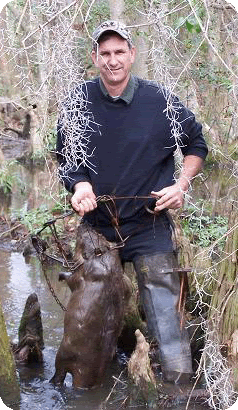
On Day Two, we get to see Kirk catch a beaver in a drowning rig that he showed how to set up the day before, and also hear a funny story about alligators. I start noticing a pattern in the way Kirk sets most of his beaver traps and think about how I might incorporate this in my beaver trapping. There isn’t much time to daydream, though, because the next thing I know Kirk is pulling more beavers out of the water and talking about alligators. There’s also an interesting catch of white-bellied beavers, a true rarity! A rain storm hits, which should make the beaver more active. A short Day Two ends with 11 beavers and an otter in the back of the pickup truck.

On Day Three, Kirk talks about the impact of temperature on beaver activity and about beaver being stolen or partially eaten by bobcats. We see lots more trapped beaver, and hear a story about how DeKalb broke his ribs and hand, and kept on trapping. The day ends with 14 beaver in the truck.

By Day Four, I’m enjoying following Kirk back to the same locations and catching critters day after day. This is especially interesting when they’re caught in locations where he made new sets earlier in the week. Kirk discusses in detail the destruction that beavers are causing to valuable cropland and infrastructure in the area he traps. I certainly appreciate this view, but it may be a bit conflicting to those who view beavers as a valuable furbearer and not so much as a nuisance. In Georgia, beaver pelts are worth very little. The main motivation for trapping beaver in DeKalb’s area is to prevent and eliminate the widespread damage they cause. Kirk really enjoys his job and feels strongly about controlling beaver numbers so that beavers and humans can co-exist without too much conflict. At the end of Day Four, the truck is loaded down with 15 beavers and 2 otters.

Trappin’ Tales ends with DeKalb discussing his love for trapping and the different aspects of being on the trapline. He truly does love what he’s doing, as you can tell by watching him on the line. Overall, the video turned out to be extremely entertaining, and I picked up a few pointers along the way. All of my trapping experiences have come from the northern U.S., so it was interesting to see the way things are done down South. It was also interesting hearing stories about water moccasins and alligators, dangers that I would never encounter on the trapline. The white-bellied beavers were a bonus as well.

The video quality of Trappin’ Tales was second to none. Picture quality is the best I’ve seen in a trapping video thus far. The soundtrack was also great. It was a real catchy tune that went well with the overall theme.

The DVD also contains two special features. One is an interview with DeKalb where he talks about what it takes to catch large numbers of beaver. He talks about the various aspects of ensuring that your trapline produces a profit. There are interesting tips here that can really help a motivated trapper. The second feature is a video of Kirk’s son, Taylor, skinning a beaver in less than two and a half minutes! This is something you have to see to believe. The kid is fast! Taylor pays his way through college with the money he makes from trapping. Kirk is obviously very proud of his son, and has passed on a great tradition and skill through him.

Overall, I feel that Trappin’ Tales is well worth the purchase. If you’re tired of all the run-of-the-mill instructional videos out there and want a trapping video that will really entertain you, try this one. You won’t regret it.

http://www.trappintales.com/.

Modern Gray Fox Trapping

by Tracy Truman

     Perhaps the only trapping book focused exclusively on gray fox, this 69 page work is dedicated to helping trappers understand the biological make-up of the gray fox and how to use that information to take more fur. With over 30 years of trapping experience, the author highlights the unique characteristics of this interesting furbearer. Tracy covers fox trapping equipment and set location, and also discusses the best lures and baits. He also provides a wealth of lure and bait formulas that have been tried and tested to appeal to grays. Tracy was one of the first trappers to test lures, baits and set construction with trail cameras, so he could see for himself which odors were most attractive, and what type of set construction cut down on misses. The book is a total of 69 pages, and uses dozens of full color photos to show set location, construction and equipment. Many of the photos are from trail cameras and show exactly how grays approach and work a set. (Tracy also produced a DVD with the same title, using actual video footage of fox working sets, lures and baits).


     This book also includes a host of scientific studies and references to flesh out gray fox densities in different geographical regions, as well as home range, Fall dispersal issues and family size groups. All of this information can greatly help you on the trapline to connect with more fox in a shorter period of time.

     Tracy is a native of Nevada but has trapped much of the West. He started trapping as a young boy and paid for most of his college education as a trapper, working on coyotes during the summer for sheepmen, and trapping bobcats, fox, coyotes and badgers during the winter fur season. He is an attorney by profession and still manages to make triple digit gray fox catches every year, as well as getting his share of those high-priced Nevada bobcats.

You can find his website here: Modern Gray Fox Trapping


Western-Nevada-Traps.com

Review by CJ Williams
    
     Ever since the days of Jim Bridger, Kit Carson and Jedidiah Smith there have always been a few trappers who stand out among the rest.  I don't know what it is about trapping, but there are always a few who excel and become the face of the trapping community.  Maybe the days of the famous Mountain Men are gone, but we trappers are still a group that recognizes and looks up to the most talented among us, especially those who support other trappers as a way of life.  One such example is James and Kelly Towbridge of Tonopah, Nevada.
     James goes by the handle "Lone Gunman" on the Wild-About-Trapping forums, where he chronicles his trapping exploits in Western Nevada.  His threads are always the most active as the forum members anticipate his updates on the coyote and bobcat count for the day.  It's about as close as we trappers get to having a prime-time mini-series to follow.

     The business that James and Kelly started naturally grew out of their passion for trapping.  One look at the dozens of photos on their website tells the story of their success.  Trapping with such intensity, there's no doubt the need for supplies was greater than that of the average trapper, and that's when the idea of a trapping supply company was born.  As James puts it on his website, "We decided to open a trap supply store for a simple reason - we got tired of waiting for our supplies or getting the wrong stuff.  I know we all hate to wait so here is my promise to you - we will send your order out the day of, or the day after, your order."

     The problem James describes is one we've all run into.  Ordering something from a big supply company is a process with many stages, each of which can get fouled up and slowed down.  James and Kelly thought to do the trapping community a service by starting a small, personable company that understands trappers.  Folks, this is exactly the kind of business we should use and support.  Trappers are a tight knit community, and the more we support each other the better off we are.

     So, if you've never visited their website check them out at Western-Nevada-Traps.  And, be sure to look for "Lone Gunman" on the Wild-About-Trapping forums.  He makes trapping look so easy that I have still not decided whether his posts are encouraging or frustrating!


The Bridger 1.5 Coilspring Trap

Bridger No. 1.65 Coil Spring Trap Jaw Spread 5 3/8"
Review by Jim Shore of Paola, Kansas
     I have been trapping 2 years and these are the first traps that I bought upon the recommendation of my brother in law, who has been trapping for a while longer than me. I am very pleased with them and have caught several coons and possum in them over the past couple of seasons. The first thing that caught my eye about them was the thick jaws when compared to other traps of the same size. I have looked over one other brand in particular in the local farm store and the Bridger is just an all around heavier built trap that will last many seasons with repeated abuse from aggressive coons. The frame is put together well and the chain is a much heavier machine chain rather than the double loop style. I also like the pan and dog on these traps. There is a bump on the dog that clicks when the pan is level (night latched) which saves the trouble of modifying the trap in that manner if you want a night latched trap. The pan is one solid piece and the dog goes under the pan instead of having a notched piece of metal welded to the pan. Modifications are easy with this trap. Pan tension is set with a steel bolt and nylock nut. The trap chain can be moved to the center just by spreading the rivet and putting it through the hole in the frame and crimping it back down and it has a long spring pin which will allow 4 coiling by just adding them on. Of course it should be baseplated if 4 coiling is done, the same with any other trap. Here are a few pics of the trap doing it's thing:


Practical Fur Handling with Tom Osborne

Review by CJ Williams
   
     Because I basically had to learn about fur handling on my own I have purchased numerous books and videos over the years. I found this video to be among the best. For the past few years I have watched it several times just before the start of trapping season, and it is just about what I needed to get me back into the groove of fur handling. Tom Osborne, the guy who does all the demonstrations, is a tough old bird who has obviously skinned thousands of various animals. His mannerisms and monologue make me laugh at times; he’s a little self-conscious but still manages some good fur shed humor. He pays attention to detail and it’s obvious that he takes pride in his work.

     What I like most about the video is that each animal has its own “chapter” so you can skip directly to the part of the video pertaining to the animal(s) you target on the trapline. I have watched the raccoon chapter a dozen times but never watched the otter chapter (I have a better chance of getting hit by lightening than catching an otter). However, the video covers just about every critter you’ll encounter: coyote, fox, bobcat, beaver, otter, muskrat, mink, ‘coon and skunk. Osborne begins each chapter with an intact carcass then skins, fleshes and stretches the pelt. He pretty much goes through the whole process with each animal. I have found this to be a very helpful video, especially if you are a beginner and don’t have a mentor to teach you first hand. Produced by T&M Outdoors with a runtime of 5 hrs.

Welcome!

Hello, and welcome to Trapping Supplies Review! I started this website because I am passionate about trapping and wanted to create a place where trappers could come and share their opinions on our sport, our equipment and our way of life. There are many valuable resources on the Internet for trappers these days, but I hope this site will fill a niche by including product reviews and tips about trapping equipment. After all, trapping requires a certain amount of gear, and we're all looking for things to make us more efficient and successful trappers. By sharing our knowledge we can get a leg up on what works and what doesn't, and spend less time and money in the search for the right equipment.  Along the way I'd like to feature other articles that highlight techniques and tips from experienced trappers, and maybe a few articles on the political and historical dimensions of trapping.

Your participation is what will make this website a success. If you'd like to contribute a review or article please contact me with your idea (click my profile link at the bottom of the sidebar on the left). Feel free to leave comments in response to any post if you have an opinion or perspective to add.

I sincerely thank you for visiting this site and participating in this venture. Trappers need to stick together like never before, not just to get the most out of our sport but also to preserve and promote the great heritage in which we stand. I hope this website will help us attain these goals.